Apart from the general Gemini 4 Argon, Google released a robotics branch. The claim is simple: the model understands the physics of a frame well enough to build a calibrated simulator from raw video and rehearse motion there before touching real metal.
The number and the demo
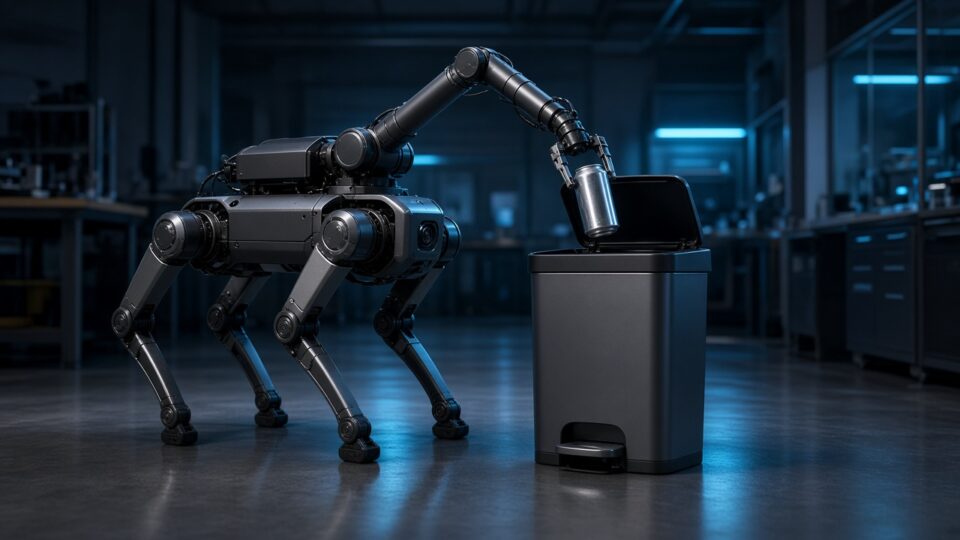
On the Embodied Reasoning ERQA bench Argon scores 87% on pure reasoning and beats the other frontier models in Google’s comparison. That test is spatial 3D tasks, not chat. In the demo a Boston Dynamics Spot quadruped with a manipulator learns to step on a trash-can pedal and throw cans. The model itself builds an articulated twin of the can in MuJoCo, checks with a camera that the foot is centred on the pedal, and only then presses in the hall.
Other clips: an arm from scratch sets down a mug and puts a napkin in it from a wrist-camera grid; in the Gemini Omni world model, arms spell ARGON in tiles in a closed loop of dozens of steps. From egocentric video or even a paper sketch they promise a physically honest twin.
Why labs care
The bottleneck for robots is not the motor, it is labelling and transfer from simulator to hall. If the model writes simulation code itself and scores progress from a frame, the “saw it — tried it in digits — repeated on metal” loop shrinks. Google talks about self-improvement on hardware and labelling dexterity after the fact. For now these are prompts and clips for developers, not firmware for a warehouse.
How to look at it
87% on their own bench and a flashy Spot are strong marketing for physical AGI. Wait for independent runs and open protocols, do not buy a “robot with Gemini” off a press release. For applied automation the question is whether the Real2Sim stack repeats a scene without an operator with a laptop standing next to it.